My Photo

Recent Comments

Your email address:


Powered by FeedBlitz

May 07, 2008

What Is Operational Excellence in Sales and Marketing?

Hello,

A reader from Microsoft recently asked me an interesting question:

  • What are the key parameters which define Operational Excellence in a sales and marketing organization?

I like the question, because Operational Excellence isn’t just a slogan or a matter of opinion. It is a fact that businesses that achieve Operational Excellence produce the most consistent growth and profit performance in the long run.

Operational Excellence is the result of applying the scientific method to achieve the goal of a business (which, as Goldratt said, is to make money now and in the future). The scientific method gave rise to the seven quality tools and the Lean and Six Sigma tool sets (among others), which enable people to measure facts so they can understand causes and effects. Armed with these insights, people can cause their companies to steadily improve quality and yields while reducing waste and cycle time.

Ask production managers how their business is going, and they’ll be able to provide projections based on carefully defined measurements of facts. They’ll be able to translate their figures from operational into financial terms in the blink of an eye. And their answers will turn out to be mostly correct in the end.

Ask sales and marketing managers how things are going, and they’ll typically say “Great!” If they’re lucky, they’ll be able to point to a big customer order that recently landed and to say “We’re ahead of plan!” However, their projections usually don’t turn out to be correct in the end.

Does the Emperor Have Any Clothes?
Sorry, but I have to be “in your face” about this. Most corporations have a pretty poor idea about what is really going on in sales and marketing. Of course, marketers and sellers (and company presidents) desperately need to know what is going on. They track their “results” like a pride of lions track straggling cattle on the African Sahara. Often these are some of the smartest people in the company, but they really don’t know what is going on.

That’s because they haven’t built the means necessary for them to know. Want proof? See how well your people can answer any of these four questions:

  • Do you really know what a lead is?
    This one is so easy, you’ve probably tried it before: Ask a couple of people in the sales department how they define the term “lead.” Now go ask a couple of people in the marketing department the same question. Chances are, their answers won’t even be close. You’ve just identified a gigantic hole in your company’s bucket. This is a fixable problem, don’t you think? Until it is fixed, marketing will continue to generate more of what sales doesn’t want while leaking profits uncontrollably.
  • Do you know which deals on the sales forecast will close?
    The accuracy of most field sales forecasts is miserable. The cost of this problem ripples like a tidal wave throughout the company. Yet, this is quite a fixable problem. With help, your sales team can build and validate a short-medium term sales forecast instrument that is accurate 90% of the time. Forecast accuracy can be gotten under control and systematically improved. Otherwise, it’s another big leak in the bucket.
  • Do you know which process improvements are working?
    Get the data for the number of orders or the revenue by time period over the past two years. Does the data demonstrate a shift in the mean of the process yield as a result of attacking a root cause? You do have a program in place for knocking out the most important reasons for lost deals, don’t you? Fail this one, and, well … how many holes are in your bucket now?
  • Do many of your corporate initiatives fail to achieve their goals?
    How many of your product launches, promotional campaigns, lead generation efforts, and other initiatives have failed to achieve their goals? Most companies live with this chronic problem. Yet it is hard evidence that someone doesn’t know what they need to know about what works out in the field with real customers.

How did you do? On any of these questions?

I didn’t think so.

Now, go over to your VP of manufacturing’s office and ask him/her some similar questions (tell him/her to be patient and that laughing at you isn’t fair):

  • How do you get people in the purchasing department and the production department to have the same definition of the term “raw material?”
  • How do you manage to continuously improve the accuracy of your production forecast?
  • Could you tell me about some process changes that have caused at least seven points above the mean in your production yields over the past two years?
  • How many of your production initiatives or projects actually fail to achieve their goals?

See the difference?

--------------------------------------------------------
How to Turn Your Sales and Marketing Into a Lean Six Sigma Production Machine That Runs Like Clockwork  (And Do It in a Way Your Salespeople Will Love!)

https://www.salesperformance.com/ExecBriefing.aspx
---------------------------------------------------------

It’s Not Your Fault, but It Is Time to Grow Up
As I said previously, marketers and sellers (and company presidents) are often among the smartest and hardest working people in the company. The fact that they don’t understand what Operational Excellence means in sales and marketing is not their fault.

At one time, manufacturing executives didn’t understand those things either. Thanks to the efforts of geniuses like Shewhart, Deming, Taguchi, Ohno, and others, they realized they needed to make their work more visible so it could be measured and analyzed...and improved.

By trying to “see” inside their manufacturing processes, diligent manufacturing executives and engineers created a market for improved sensors and control systems and production management systems. Now the inside workings of molds, extruders, and production equipment of all types are taken for granted. So is measuring the conversion of raw material to work in-process and finished goods, making it possible to translate operational measures into financial ones.

What does Operational Excellence look like in sales and marketing? Here are some prerequisites for being able to achieve it:

  • Value = actions by the customer.
    Recognize that marketing, selling, and servicing exist to serve the customer. The value created (for the customer and for your own company) is measured by the customer’s responses to your actions (headlines, offers, requests, proposals, etc.). Actions without customer response = waste.
  • Banish the functional mindset. Replace it with systems thinking.
    Your customer wants to get the results you promised. Their relationship is with your company as a whole, not the marketing department, salesperson, or service representative. Those functions are interdependent; they must be managed as a system. Optimizing one function at the expense of another causes your company to fail its promise to the customer. Period.
  • Make actions and results visible.
    Language is a tool for dealing with the facts of reality. Every word, concept, and generalization should be traceable to the specific facts and characteristics that give rise to them. Creating operational definitions is a critical step, especially for the stages of production (such terms as “leads” and “qualified opportunities”). Don’t allow “floating abstractions.” All words should mean something measurable in reality. Everyone should be able to trace those meanings.
  • Have the discipline to “close the loop” on your process.
    Executives are prone to “defining the sales process” and leaving the details up to everyone else. Employees are prone to “lip service” to keep the boss happy and avoid the uncomfortable. Don’t fall into either of these black holes, because you’ll never come out. The sales process must be “home grown.” Break it into its smallest components and learn how salespeople solve those problems. See how their solutions vary and why. That is where your real sales process is. Always remember that.

Why Pursue Operational Excellence?
Companies whose sales and marketing departments choose the path toward Operational Excellence will have a variety of competitive advantages:

  • Their knowledge of what their customers respond to will be clearer and more timely.
  • The ideas that flow from customer and salespeople’s insights will drive a variety of experiments, each of which increases the company’s knowledge of how to make deals flow faster and how to make more money in their markets.
  • These businesses will understand where their bottlenecks are and the financial impact of potential improvements in their processes.
  • They inherently take less risk, because they have established a range of simultaneous experiments, the results of which provide the evidence needed by product managers, marketing managers, and sales VPs for decision making. Initiatives that don’t meet expectations are the exception, not the rule.

The predictability and stability of their financial results will make them more attractive to investors, who will be willing to invest more money in them than their competitors.

And those are just a few of the reasons. Can you think of others?

Michael J. Webb (with Robert Ferguson)
May 7, 2008

April 29, 2008

How to Avoid the Fatal Sales Process Mistake Most Sales Managers Make

Hello,

A few months ago, two sales managers, I’ll call them Frank and Betty, were stymied by a serious problem. They knew how to make their numbers, yet results weren’t happening.

Although their company was small, they had created a management system as sophisticated as those of much larger companies. However, they made one fatal mistake.

Below is a description of their system. Can you spot the flaw?

  • Their product led their market niche, with more than 5,000 customers and lots of testimonials and successful case histories.
  • Their sales process included descriptions of activities for each step.
  • Compensation was competitive with other companies who were looking for similarly talented salespeople.
  • They knew the personalities who could best succeed, so they screened candidates carefully.
  • Their sales training demonstrated the company’s proven ways of qualifying prospects, conducting demonstrations, making proposals, and asking for orders.
  • Their CRM system was configured with the stages of their sales process and the activities required for each stage.
  • To help keep the pipeline moving, they established expectations for the amount of activities (such as phone calls, demonstrations, commitment letters, etc.) each week.

Now, if you guessed that this might be a technically-oriented company, you are right. It was a business-to-business software company that sold mostly over the phone. When I was there, it was clear that people enjoyed the camaraderie of a small company and liked their jobs as well.

Yet the numbers were not happening.

The Symptoms
Frank and Betty were frustrated, to say the least. As we asked them to describe what was happening, a familiar story unfolded.

Frank: I think a lot of my guys. They’re working hard. But when the numbers aren’t  happening, we have to be enforcers. It makes me feel like I’m acting like their mom, but what else can I do?

Betty: We’ve got to figure something else out. I still believe that if they hit their targets, things will turn out in the long run. It is just hard to keep revving them up to achieve that level of performance.

Frank: Tell me about it. Jason, my best rep, had to leave early for a doctor’s appointment the other day. He hadn’t made his quota for prospecting calls all month. I like the guy, but when I had to put my foot down, it wasn’t any fun at all.

Betty:  Well, at least you don’t have to deal with Kamal. He almost always hits his call targets, but hasn’t made his quota for a long time. I guess I’ll have to put him on a program and start looking for someone else again.

I know you’ve heard these frustrations before, right?

Managers carefully think out their processes and the activity levels, and still things don’t work out. Or, they work only when the market is good, but not when things dry up.

You’ve been there, and so have I. It feels like the rat race was somehow converted into a maze. It is still a race, but most of the rats are stymied for some reason or other.

So what’s the problem? Have you spotted the flaw yet?

Quantity (Activities) vs Quality (Results)
Most people in sales assume “the numbers game.” I learned it years ago when my sales manager said “If you throw enough spaghetti on the wall, some of it will stick.” It stuck with me, so to speak, because working our way through college, my dishwashing pals and I had thrown lots of spaghetti on the walls. Literally!

Unfortunately, the numbers game assumes quantity is the right strategy. More volume. More calls. More deals. Some of them will close.

This is true to a certain extent. If you don’t know how to improve the quality, it has to be true.

However, there is much more leverage if you can figure out how to increase the quality. A lot more spaghetti sticks to the wall when the noodles are just right.

For many years in sales, mangers had little idea about how to increase the quality. Fortunately, that is changing. Here were the keys Frank and Betty needed to turn their operation around:

1. Define the buying stages (from the customer’s perspective)
What problems cause them to start looking into the kinds of things you sell? What kind of information are they looking for when they are not yet ready to buy? What kinds of things happen internally that cause them to get serious? Who is typically involved in those situations, when they are almost ready to buy? What can your company do to help them get through each of those stages?

2. Define what quality means
What, exactly, is a qualified opportunity? What are the observable characteristics? One crucial factor is to identify this from the customer’s perspective, as well as your own. Develop these characteristics into a series of numerical scales (you can if you try hard enough), and you can perform some extremely valuable experiments. These experiments usually enable you to give salespeople a tool that will tell them (with 90% certainty) which deals will close.

Paying attention to the stages your customers go through and the quality scores of those deals gives you a powerful insight into your deal flow. Productivity means getting customers to go to the next stage and knowing they are even more highly qualified when that happens.

This is the difference between managing based on activities (which ignore quality) and managing based on results (which respects quality). Activity targets do not equal productivity. Far from it!

Salespeople know this viscerally (although they may not be able to articulate it). They may (or may not) know how to move deals along. But if you, the managers, do not know how to move deals along, everyone is lost in a maze.

-----------------------------------------------------------------------------------------------------------------
How to Turn Your Sales and Marketing Into a Lean Six Sigma Production Machine That Runs Like Clockwork (And Do It in a Way Your Salespeople Will Love!)

https://www.salesperformance.com/ExecBriefing.aspx
-----------------------------------------------------------------------------------------------------------------

Productivity in Sales Equals Customer Actions, Not Activities
Frank and Betty knew well enough how to move deals along. They just had difficulty translating it into their system. The solution to their dilemma was to help them through the stages of sales process improvement: They quickly defined their customer’s journey, aligned their activities to those stages, and developed and statistically validated quality criteria.

The final change, which fixed the fatal flaw, was in the way they used the CRM.

No longer would they track salespeople’s activities each week. Instead, they tracked the flow of qualified opportunities. Only then could they get down to the brass tacks of helping salespeople sell. Activities, such as ways to qualify, do demos, etc., were tools salespeople could use as they saw fit.

They are craftspeople in a performing art, after all. When they got to a tough spot, their managers were there to help them analyze the situation and select the right tools (and even invent new ones) from the options available.

Salespeople and managers respected each other more. Forecast accuracy improved. When the funnel was low, the focus turned to lead generation instead of fruitless “closing activity.” Jason went on to win the salesperson of the year award. Kamal went on to be a highly valued member of the customer service team.  And the rat race was good, as it should be.

Michael J. Webb
April 29, 2008

April 22, 2008

How Well Does Your Company Help Salespeople Sell?

Hello,

I’m on a quick trip up to New Jersey and back, but wanted to get this story off to you.

If you’ve been a salesperson, you’ve felt the pressure of needing to get customers to buy. You’ve also known the frustration of not having the knowledge, resources, time, or the tools to do the job properly. If you’ve been a sales manager, you may have tried to get your company to invest in some of those resources and tools. However, you probably had a hard time “proving” the value of those tools in the end.

I had an opportunity to see this problem (and its solution) recently from a customer’s perspective, and you have too. I needed term life insurance. If you are like me, you don’t enjoy the act of buying this product. I just wanted to make a decision and get on with it.  (Note: The story I’m about to tell you may not be representative or typical of the ordinary transaction.)

The Mirage of “Certification"

I had been working with Ralph (not his real name), a “Certified Financial Planner” here in Atlanta. Ralph ’s recommendation (consistent with his “highest death benefit for the lowest premium” philosophy) was a policy from Protective Life, a traditional carrier offering commodity insurance products. I wanted a level term policy so the premiums would not increase for the next ten or twenty years. Ralph pointed out that I could convert the policy to a permanent insurance product (meaning I could buy an “upgrade” to the kind of policy that remains in force after the premiums are “paid off”).

Within a few days, I received a call from my Northwestern Mutual agent, Carl (also not his real name). I’ve owned some insurance from Northwestern for more than 20 years, and the new policy I was looking at would replace one of them. “I see you are looking at another company’s life insurance product,” he said. “Why didn’t you call me to discuss it first?”

Now, I’ve known Carl for a long time. I have no reason to distrust him, I’m just indifferent. I rarely talked to him over the years. Usually, it was when I called to borrow money against some of the other policies I owned (where that was allowed). Carl was always trying to get me not to borrow, but to spend (save) on new policies instead.

Northwestern Mutual, is on the opposite end of the value spectrum from Protective Life. (I’m not knocking it, just comparing and contrasting.) Northwestern is noted whole life, which costs more, but accumulates cash value. In the end you’re supposed to come out way ahead. Northwestern is the only remaining “mutual insurance company,” meaning that the policy holders are also stock holders. This supposedly increases financial returns on their products. 

These Guys Don’t Like Each Other!

To put it kindly, Northwestern (and other companies like it) are generally ridiculed by most of their competitors, who sell the commodity-type product. I naturally assumed Northwestern’s term life products would be far more expensive than anyone else’s. Because I was not interested in cash value, but only death benefit at this point, Ralph, acting as my “Certified Financial Planner” agreed, so we hadn’t bothered to talk to Northwestern.

Carl, naturally, had different ideas. He insisted that he could be competitive on term policies and asked for the opportunity to quote. I reluctantly agreed. 

In the end, I was very glad I made this decision.

The Race Was On

Soon I had two virtually identical term life quotes in hand (contrary to Ralph ’s prediction). The difference, Carl claimed, was in the kind of policies each was upgradeable to. Deciding that such an event was a possibility, I asked both fellows to quote the upgrade for me.

Thus I began an unpleasant journey through a mare’s nest of terminology about investment projections, proformas, disclaimers, death benefits, cash values, and mud slinging. Ralph  claimed all sorts of disadvantages about Northwestern (old outdated product, you can do much better investing money somewhere else, way too expensive for what you get, etc.). Carl, for his part, claimed that there wasn’t much difference between the two term policies, but there was a dramatic difference in what you could upgrade to. 

Both individuals are supposed to be professionals, yet no matter how I tried, I couldn’t connect the terms and words from Ralph ’s world to those of Carl’s. Ralph  reminded me again of his objective status, as “Certified Financial Planner,” so I decided to take him up on his claim.

“Ralph ,” I said, “you are claiming Carl’ proposal is not worth the paper it is printed on, yet I have no reason to believe the fellow is lying (heck, he’d had the same job for twenty years!). I’d like to pay you a professional fee to get on the phone with Carl and me and define our terms so we can get to the bottom of this.”

To my surprise, Carl refused!

“Mike, there is no more information you need to know. It is right there. He is telling you a load of crap, and you ought to report him to the Insurance Commissioner. I don’t want any part of it.”

Dealing with the FUD Factor

Since I trusted Ralph  too I was perplexed, to say the least. The FUD Factor at its finest (“Fear, Uncertainty, and Doubt”) was at work. All good salespeople know and use the FUD Factor, right?

I looked on Google for scams (searches for things like “Protective Life Sucks” or “Northwestern Mutual Scam”). The search turned up nothing. I searched also for investment comparison results using terms like “Northwestern Mutual as an investment,” and “Northwestern Mutual comparison.” Oddly, I came up with almost nothing. I found only a few things published by employees of Northwestern itself. I could find no third-party corroborating evidence of Northwestern’s superior policy investment performance. That surprised me.

Why were there be no consumer-oriented articles from investment advisors objectively comparing the performance of financial instruments from such well-known companies?

Finding Something Believable

So, I went on Google again to look for an honest-to-god life insurance consultant (who really does not get paid by insurance companies) and found one: www.glenndaily.com. Glenn is paid by individuals and corporations to work through this sort of problem. I got on the phone with him and was immediately impressed.

Glenn didn’t just take my money, he screened me first, making sure he understood me, my situation, and exactly what I was trying to do. He walked me through an automated database comparing all the policies from ALL the life insurance carriers (Sheesh, what a total commodity that stuff seems to be!). Then he started naming specific information, dates, companies, and lots of other evidence corroborating the claims Carl had made. This was the proof I needed to make my decision. It was evidence I could not find on my own. 

Glenn Daily solved my problem in a way that Carl, the agent, could not, because 1) Carl didn’t have it, and 2) Carl was an interested party. In the end, I decided to buy the Northwestern policy. But the decision was at a far greater expense in aggravation and time than it should have been. (I’m not saying you should make this same decision, by the way. Your circumstances could be different. I’m saying that the two sales people did not – heck they could not – do their jobs. Their companies did not set them up to win.)

Why?

Let me focus on Northwestern, because I know them a bit better (though I’m no expert). From my perspective, Northwestern’s sales and marketing is stuck in the Dark Ages. From what I can see, they have not challenged their views about the role of their “vaunted sales force.” After all, these fellows are paid the highest commissions in the industry.

Now, from talking to Carl, I’m pretty sure most of those agents would gladly give up some commission if only they had an easier time of finding, winning, and keeping their customers! (to win my business, he had to discount the maximum amount, which came out of his commissions. He had to work really hard, spend more time trying to win my business. But he was at a tremendous disadvantage (in my case) without some kind of credible, third party corroborating evidence.

What could Northwestern Mutual do? Here are just a tiny fraction of the possibilities:

“Reason to Believe”

I bet there are fifty individuals going through my exact problem at any given time in North America. They have life insurance salespeople dukeing it out over what they should buy. Neither salesperson has much in the way of believable third-party evidence supporting their claims. Some salespeople are positively misinformed.

Why doesn’t Northwestern provide more reasons to believe, in the form of third-party evidence, examples, case histories, and industry spokesmen?  They could, for example:

  • Hire a group of fellows like Glenn Daily to develop a series of informational articles along the lines of “The four biggest myths in the life insurance business” or “Six things to watch out for when buying term insurance for your small company employees.” I would have read such material closely.
  • Why not educate some of the more popular investment advisors about Northwestern’s true value proposition and track record? Some of them might see it as an opportunity to garner additional market attention by going against the “traditional” mindset that all whole life insurance is a bad investment.
  • Become involved with whoever “certifies” industry financial planners and make sure they have at least some understanding of the differences between Northwestern (and the like) and other carriers.   

---------------------------------------------------------

How to Turn Your Sales and Marketing
Into a Lean Six Sigma Production Machine
That Runs Like Clockwork
(And Do It in a Way
Your Salespeople Will Love!)

https://www.salesperformance.com/ExecBriefing.aspx

---------------------------------------------------------

Nurturing Relationships

Over the years, poor Carl had little to offer me but a lame newsletter (written by his corporate headquarters) and his creativity in striking up conversations with me. In that time I’ve gone to several financial or retirement planning seminars. Yet Northwestern never contacted me to help educate me, and they were never mentioned in any of these seminars. Why?

At some point, Carl knew I had started my own business. Why didn’t he have some information for small entrepreneurs about how to use your personal savings most wisely when taking this kind of risk? I would have read such things, and appreciated Northwestern for bringing it to my attention.

Finding Prospects

At the beginning of my search, I went to an industry website which required me to log in to get life insurance quotes. Naturally, I was deluged with irritating phone calls from starving agents who tried every trick they’d been taught to try to get an appointment with me. Lame, lame, lame. Aren’t there better ways of establishing relationships with people and helping them in more productive ways?

The Failure of Marketing

From what I can see as a customer, Northwestern is doing very little to help salespeople sell. No doubt, their marketing department is stuck in the traditional functional mindset, preoccupied with “branding,” and probably very nervous about talk of “accountability.”

Executives in financial companies generally have a difficult time grasping the “production process” paradigm, which makes it harder for them to recognize, much less solve, many of their sales and marketing problems. Of course, experience with the concept of educating prospects through their “Customer’s Journey” is what enabled me to suggest various things Northwestern could do above, and they don’t have this experience. It is a radical perspective that is not possible when you have the functional mindset.

So, perhaps it is unfair for me to imply that Northwestern’s marketing department has failed. The role I’m advocating, that of “Sales Process Improvement Department” isn’t something  most companies have thought of yet. 

But that is why this story might be useful to you: As a customer, it was harder for me to make a good decision than it needed to be. Northwestern left the job up to the salesperson. Carl was actually a good salesperson. He just didn’t have all the tools and support needed. He said he sees this kind of problem again and again as he tries to do his job.  (So do I!)

He’s just not in the right spot to do anything about it.

What tools do your salespeople need to get their job done? More importantly, who in your company is doing something to solve that problem?

Until next week.

Michael Webb
April 22, 2008

April 15, 2008

Battles, Statistics, and Order Getting All Have Something in Common

Hello,

Who is your favorite heroic historical figure?

I never thought I would be this way, but in recent years I’ve found biographies of George Washington, Thomas Jefferson, Isaac Newton, and others to be fascinating. Once you’ve been out of school for a while, I guess you develop more of an appreciation of what it took to accomplish what they did.

For example, I’m reading a biography of Richard Feynman right now (Genius: The Life and Science of Richard Feynman, by James Gleick, Vintage Press, 1992) http://tinyurl.com/5sofny.

Feynman’s experience in WWII as part of the team that developed the atom bomb at Los Alamos, New Mexico, was dramatically different than that of Freeman Dyson, a British subject and another math whiz. Check this out:

Dyson’s war could hardly have been more different from Feynman’s. The British … assigned him to the Royal Air Force bomber command in a Buckinghamshire forest, where he researched statistical studies that were doomed, when they countered the official wisdom, to be ignored. … He and others in the operational research section learned—contrary to the essential bomber command dogma—that the safety of bomber crews did not increase with experience, that escape hatches were too narrow for airmen to use in emergencies; that gun turrets slowed the aircraft and bloated the crew sizes without increasing the chances of surviving enemy fighters, and that the entire British strategic bombing campaign was a failure.

Imagine not just struggling to help your company succeed, but fighting battles where people died instead of being laid off. Then, imagine that your work proves that many of the cherished beliefs of your superiors were not just mistaken, but they were continuing to kill people on a daily basis!

This reminded me of three things:

First was the great example in Peter R. Scholte’s “The Leader's Handbook: Making Things Happen, Getting Things Done” http://tinyurl.com/6jrj5k, where the generals in the Israeli army punished the pilots when they did badly and rewarded them when they did well. The generals were not surprised that when they punished people their performance went up. But they were amazed that when they rewarded
people, their performance was worse. Naturally, they decided to stop rewarding people! Makes perfect sense, right? (Unbeknownst to the generals, the pilots were in the clutches of normal variation; systemic variables beyond their control. Reward them, punish them, it really didn't matter. ... Sound like any salespeople you know? It does to me!)

Second, it reminded me of Ian Ayre’s book “Super Crunchers: Why Thinking-by-Numbers Is the New Way to Be Smart” http://tinyurl.com/5urpho. Ayre provides numerous examples, especially in compelling fields like medicine, where strangely, the scientific method still, to this day, is barely starting to take hold. He shows how time and again the measurement of actual events and outcomes in
organizations reveals things that run counter to the leader’s awareness and beliefs.

Taking pains with your business to measure what actually happens with customers is a huge source of profit and competitive advantage in companies today. Marketing and lead generation provide enormous opportunities to start uncovering what customers want, what they react to, and what they don’t react to. For example, Flint McLaughlin at www.MarketingExperiments.com is a big believer in measurements, as marketers should be. He is conducting a webinar this week on the topic, as a matter of fact, and I highly recommend his materials.

Most marketers suffer from a lack of systems thinking, although it is often not their fault. As I have written previously, their organizations force them into a sort of functional view, where they are evaluated on the quantity of “leads” they produce rather than the quality of them. (A guaranteed way to waste money.)

The approach required for systems thinking in marketing and selling is to carefully define the qualities that make up highly qualified opportunities. As I have also written before in this space, my clients routinely learn powerful things when they take a scientific approach to their qualification criteria (see Chapter 5 of “Sales and Marketing the Six Sigma Way,” for example). Think you are better at closing technically sophisticated prospects as opposed to unsophisticated ones? More often than not, what you think you know is not so at all. Better check your facts: I’ve never had a client who didn’t learn something huge when they tested theories such as these.

Measuring the observable characteristics of opportunities in the field and correlating them to whether the deals are won or lost is like getting Freeman Dyson’s British bosses to listen up to the facts about their lousy bombing strategies!

Those kinds of things can really change the outcome of a war.

Until next week,

Michael J. Webb
April 15, 2008
---------------------------------------------------------------------------------------------------------------------
How to Turn Your Sales and Marketing Into a Lean Six Sigma Production Machine That Runs Like Clockwork (And Do It in a Way Your Salespeople Will Love!)

https://www.salesperformance.com/ExecBriefing.aspx

April 09, 2008

Root Out the Marketing and Selling Disconnect

Hello everyone,

Running between some vacation days and client appointments this week, I was interviewed by Forrester Research late last week on the topic of how to get sales and marketing to cooperate better. This week’s article deals with that very issue. Originally published in RainToday a couple of years ago, it’s worth revisiting.

Until next week.

Michael Webb
April 9, 2008
www.salesperformance.com

----------------------------------------------------------------------------------------------------------

Root Out the Marketing and Selling Disconnect

Originally published Aug. 3, 2005, on www.raintoday.com

The VP of Sales and the VP of Marketing were squared off in a debate about how to invest the sales and marketing budget for the coming year.

  • Sales VP: "I want to create a new position and hire a Director of Sales and five additional salespeople."
  • Marketing VP: "I want to invest in a marketing and advertising campaign to make the B2B brand stronger."

If the budget allows one or the other, but not both, which is the right decision to make? Isn't this a "chicken or egg" dilemma? Which comes first—sales or branding? Is there even a solution to this perennial problem?

You bet there is. To see it, you have to get to the root of the problem, which is this:

Which choice will create more value for the customer?

What Value Does Your Sales Process Create?
Self-interest makes prospects read headlines and respond to promotions. Decision makers are influenced by what's in it for their companies and for themselves. As individuals, marketers and sellers work hard to identify the self-interest of prospects and customers so they can be valuable to them.

Too bad most businesses don't see the purpose of marketing and selling in terms of their value to the customer. Instead, they traditionally see marketing, selling, and servicing as activities with separate purposes. Marketing designs communications about the company and its products and "gets the word out" via branding and market-awareness exercises. The sales force turns over rocks trying to find opportunities to make their quotas. The service department tries to respond to customer needs while staying within budget. Each department essentially fends for itself.

This approach suboptimizes results because that is what it is designed to do! It spawns conflicts over resources because of its faulty assumptions about what marketing, selling, and servicing really do.

Anything Not Creating Value for the Customer Is Waste
Companies would become a lot more effective and efficient (not to mention more profitable) if they designed their marketing, selling, and servicing activities to solve the prospect's or customer's problems instead of pushing their product or touting their "brand."

Do you know what hinders people in your marketplace from doing what they want to be doing? Do you know what it costs them to deal with those problems, and what work-arounds they use? You should. You should also know how your company's offer can alleviate those problems. Answering these questions is the key to getting people to:

•  Read your advertisements
•  Take actions such as inquiring for more information or opting-in to some offer
•  Take your salespeople's calls and share information
•  Consider salespeople's proposals seriously
•  Buy your company's solutions

The work of your company's marketing, selling, and servicing departments should be a production system designed to generate actions like these. If it does, you are creating value. If people don't take the actions you want them to, what you are producing is waste.

----------------------------------------------------------------------------------------------------------------
How to Turn Your Sales and Marketing Into a Lean Six Sigma Production Machine That Runs Like Clockwork (And Do It in a Way Your Salespeople Will Love!)

https://www.salesperformance.com/ExecBriefing.aspx
--------------------------------------------------------------------------------------------------------------

The Goal: Making Money Now and in the Future
Marketing, selling, and servicing are a production system for finding, gaining, and keeping the right customers by solving problems for them so they can make more money. You might initiate promotions, hoping prospects will respond. Or, perhaps you react when prospects take certain actions. Either way this production system must have a procedure with measurable steps.

In such an environment, marketing is anything that makes sales easier. Marketing should be analogous to engineering: it must find the niches in the market and develop the most efficient ways of mining them. Sales is like production, implementing the activities that cannot be automated. The analytical tools of the quality movement can and should be leveraged to identify causes of bottlenecks and variations in this production process so corrective actions can be taken.

Operating this way is the key to an ever-growing stream of profitable business. It is also the best defense against changing markets, competition, and technologies.

Root Out The Dilemma
If marketing, selling, and servicing are seen in terms of producing value for the customer, so-called "conflicts" between marketing and sales dissolve easily. Let’s consider the "conflicting" goals again:

  • Sales VP: "I want to create a new position and hire a Director of Sales and five additional salespeople."
  • Marketing VP: "I want to invest in a marketing and advertising campaign to make the B2B brand stronger."

What value will either of these actions create for prospects, clients, or customers? What actions will they take as a result? How can you measure it? Chances are, both executives will have to do some thinking to answer those questions. That is good because the result of their discussion might be the first time they have actually identified their production system (aka, their sales process). In addition, it will cause them to design an approach that creates value for customers, so customers are more likely to follow it.

Once they have a process customers follow, improving results is a matter of doing experiments. It is likely that some entirely different ideas would surface for improving results. Regardless of what they decide to do, they should be able to run two slightly different processes side by side (or sequentially) and be able to measure the result. Hire one or two salespeople or test part of a brand campaign in one market segment. Measure the results.

Improved results are proof you are on the right track, and provide valuable feedback on what your market wants. Best of all, this establishes a framework for  measuring and maximizing the talents of marketing, sales, and service people in the service of the customer, as well as to your own company.

Michael J. Webb
April 9, 2008

April 02, 2008

How Much Sales Process Is Too Little? How Much Is Too Much?

I had lunch last Thursday with a very smart woman who just started a six-figure executive sales position in a health-care company. She seemed a little frazzled as she described the sales process at the new company: “It’s like, ‘Oh Boy. Everyone Go Sell!’” she said. It had taken her a week to figure out things such as which six people had to approve client proposals, who last worked on the hospital account she was calling on, and how to submit expenses. She found another salesperson who supposedly had developed a customer-oriented “sales process” on her own, only to be told it was not for general sharing.

Companies like this (who aren’t even doing “Sales Process-Lite”) essentially have a learning curve for each salesperson, and it takes a long time for those salespeople to independently figure out how things should work. The sales organization as a whole gains nothing from their progress, because the learning is ad hoc, not systemic, and has limited transferability to others. Such a company is at level 1 in the stages of sales process improvement that I wrote about last week.

On the other end of the spectrum, there are companies whose salespeople are wrapped up in heavy-handed process compliance and data entry. Salespeople in a major bank, for example, are expected to stick to memorized scripts. A major networking equipment company penalizes salespeople when their orders don’t exactly match forecasts. (Imagine getting penalized both for forecast deals that go south AND for bluebirds that were not on the forecast. Sheesh!)

The sales process in this company feels much more like a manufacturing process because it emphasizes rigid compliance (no room for local variation, creativity, or participative involvement).

Although the second company would say it has a sales process, I believe both are probably the flip sides of the same coin. Whether management abdicates the sales process to the salespeople (“it’s their problem, just get rid of them if they don’t sell”) or lays down rigid work steps with arbitrary “percent chance of close” assigned to each one (or whatever), it is not really in a dialogue with customers. Neither company is learning from its salespeople (who often have unique insights) or from customer behaviors (which are always changing). Yet, this kind of learning is some of the greatest intellectual property any company can have.

In a sales and marketing operation, the greatest power of a process approach lies not in eliminating variation (as it does in manufacturing), but in providing a means of communicating complex, nuanced information that cannot be learned in any other way. Here are two examples:

Direct-response Advertising
Skilled pay-per-click advertisers use Google AdWords to continually test the market’s responses to different words in those little text ads that appear all over the Internet. This experimentation gives them penetrating insights into how their customers look for information, thereby increasing their response rates (sometimes dramatically). (I learned about this sort of thing from Perry Marshall.) Their process is to experiment with ad copy alternatives, measure the responses, and use the results to improve the next experiment. It is a sort of conversation, but the customer is providing actions, not words. Each experiment is essentially a different little sales process. After numerous experiments, they learn how to increase the click-through rate. The advertiser learns to sell better.

----------------------------------------------------------------------------------------------------------------
How to Turn Your Sales and Marketing Into a Lean Six Sigma Production Machine That Runs Like Clockwork (And Do It in a Way Your Salespeople Will Love!)

https://www.salesperformance.com/ExecBriefing.aspx
---------------------------------------------------------------------------------------------------------------

Complex Sales Process in the Automotive Industry
In the mid 1990s Bob Ferguson worked closely with DuPont Automotive’s refinish business unit, whose market share was in second place and declining. They established a sales process for their outside sales force (which was distributed across North America) and a sales management model based on Deming’s PDCA cycle (plan, do, check, and act). The idea was to use process tools to enable salespeople and managers in each region to know what they are doing now (by defining it in process terms), so when they did something that worked better the next week, they could know why. When they spotted something that seemed to work better in one region, they would try it for three months in a different region. If it worked better there too, they refined it and rolled it out to the entire sales force.

By this means, DuPont was able to achieve a substantial number of improvements in their sales process (fed largely by ideas from field salespeople rather than by MBA marketers who never carried a bag). The company transitioned from girly calendars to sponsoring NASCAR races. They learned that the traditional (but costly) way they did demonstrations was largely ineffective. One salesperson in California developed an approach for customers facing environmental regulations. Once it also worked in another region, DuPont was able to roll out its first nationwide green initiative, which was successful. The combined force of these changes and many more enabled them to end up dominating their market. Ultimately, the General Managers involved were featured on the cover of Fortune magazine. DuPont’s case is a great example of using sales process as a management tool, producing market advantages and improvements.

Conclusion
In most sales and marketing organizations, when someone does something that works better, the organization doesn’t know why it worked. The power of process thinking is in its ability to harness this knowledge for the benefit of the organization. This enables management to orchestrate not only a dialogue with the customer, but a dialogue with the sales force as well.

By Michael J. Webb with Robert K. Ferguson

----------------------------------------------------------------------------------------------------------------------

I spend a lot of time helping executives understand that the sales process is more than just what salespeople do; it is about aligning the entire organization around the customer’s journey. In this way process thinking provides management the most powerful tools imaginable to grow the business. I’m constantly on the lookout for examples and illustrations of this concept. If you have a story you’ve lived through, send it my way (mwebb@salesperformance.com). I’ll publish it here for you.

March 26, 2008

What Prevents Sales Forecasts from Being Accurate as They Could Be?

Hello,

I’m rushing this morning, in California with a client.

Fortunately, I had four hours on the plane last night to work on this week’s article.

Forecasting is a problem, but it is caused by an even deeper root cause. Getting to the bottom of that is the key to improving everything else in the sales process.

I hope you enjoy it … pass it along to a senior executive you know.

And, of course, let me know what happens!

Until next week.

Michael Webb
March 26, 2008
www.salesperformance.com

---------------------------------------------------------------------------

What Prevents Sales Forecasts from Being as Accurate as They Could Be?

An incredible variety of reasons prevent sales forecasts from being accurate. Consider this partial list (there are many more):

Factors involving the prospect

  • Companies make decisions for wildly different reasons,making them hard to predict.
  • Competitive activity varies in different parts of the country.
  • When several people are involved, they may not decide until the last minute.
  • They may not want you to know what they are going to do.

Factors involving the seller

  • Seller has not precisely defined characteristics of a qualified prospect.
  • Sales opportunities are not consistent with the definition of qualified opportunities.
  • Salespeople do their jobs differently and have different skill levels
  • The forecasting process is not well designed.
  • Market channels or direct salespeople have reasons to withhold information.
  • Your company has not studied the factors affecting deals that are won or lost.
  • You rely on salespeople’s opinions (rather than facts and data) for the sales forecast.

If more than a few of these things are true in your organization, can it be any wonder why sales forecasts are not accurate?

The Root Cause of Forecast Accuracy Problems
On the face of it, improving forecast accuracy appears to be a classic opportunity to apply process improvement. After all, manufacturers also have trouble with forecasts, and process approaches work there. “Bad processes create bad data” say Tom Wallace and Robert Stahl, authors of “Sales Forecasting, a New Approach” and “Sales and Operations Planning.” Both books were written to help manufacturers improve their decision making around forecasts. “Improve the process, and the data improves as well.”

Unfortunately, it doesn’t work well at all in sales and marketing. For example, a technical services firm in Minneapolis decided to apply a process approach to their forecasting. They even installed a $1.2 million Siebel CRM to assist. When finished, their forecast was indeed much more accurate than before. Trouble is the forecast was for 50% of what the business plan called for.

This sort of problem happens a lot in sales and marketing. When companies try to create what should be reasonable improvements, such as increasing forecast accuracy, transitioning to “solution” selling, generating more “leads,” implementing a CRM system, or any of dozens of
other well-intentioned goals, a frustrating scenario plays out.

They go through the steps, they “define the process” as it currently is, implement their improvements, and … not much else happens.

When is the last time you heard of a company that actually achieved objectively measurable and sustainable improvements in the yield of their sales and marketing processes? Chances are it has been a long time.

Tom Wallace and Robert Stahl were talking about the forecasting process. For them, the production process itself is well understood–a given. Unfortunately, in most companies, very few people have any idea how to get customers to buy.

The sales process is how you get customers to buy. It is the sequence of interactions that generate interest, interaction, information, trust, and ultimately, trade. Ignorance of how it works is the root cause of forecast problems and everything else that is wrong with sales and marketing as well.

---------------------------------------------------------------------------
How to Turn Your Sales and Marketing
Into a Lean Six Sigma Production Machine
That Runs Like Clockwork
(And Do It in a Way
Your Salespeople Will Love!)

https://www.salesperformance.com/ExecBriefing.aspx
---------------------------------------------------------------------------

Process Approach Makes Creating Waste Easier
Obviously, the purpose of sales and marketing is to get customers to do things they probably would not do without our help. Buyers and sellers are inherently not aligned.

For example, your company wants higher prices, your customers want lower prices, and more features in the bargain. Or, the company wants revenue this quarter, yet customers would prefer to delay their purchases. Or, perhaps some of the customer’s managers are interested in
your new product launch, yet it is not even on their decision-maker’s radar. Worse, most prospects might be indifferent to your important product.

Customers only serve their own selfish interests. Successful sellers try to figure out who in the market is going to make a purchase decision, get to know them well enough to learn what their interests are, and look for common ground (sometimes by getting their own company to bend). Although it is unintentional, from the sales person’s (and the customer’s) vantage point, your company is likely to be doing stupid, shortsighted things (price too high, not enough features, pushing too hard, etc.).

Salespeople are asked to sell products customers don’t want to buy. They observe “branding exercises” and so-called “lead generation” that doesn’t produce qualified opportunities. They suffer with product literature that doesn’t help customers buy, because the people who wrote it
had no idea how to do that. They deal with cumbersome reporting and paperwork that takes time away from helping customers.

From the sales department’s perspective this is life. The rest of the company just isn’t paying attention.

Now, add the process improvement do-gooder drawing lines and boxes on PowerPoint slides. (I can say that, because I’ve been one of those for years.) When the process mapping is finished, what good is it if nothing in the sales person’s life changes for the better?  Worse yet, what if the only thing that changes is a requirement for salespeople to enter more data and go through more procedures which add no value to them or the customer?

Process initiatives that do not make it easier for salespeople to sell (or for customers to buy) create waste. Pure and simple.

How do you make it easier for salespeople to sell?

The Right Way to Apply Process Improvement
If you design a sales process that attracts and engages the customer every step of the way, customers will follow it. And, if customers follow it, salespeople will too.

Applying process improvement to sales and marketing should be easy. After all, the purpose of both activities is the same: to create value for customers. In sales and marketing, value is created when you get prospects and customers to take the actions you want them to take. There are three stages of production: Find, Win, Keep.

  • Find more qualified, sales-ready prospects. The means of  identifying (VOC), attracting, and qualifying them (lead  generation) is well known. (Check out John Fox’s www.marketing-playbook.com, for examples.) Leaving this crucial work up to the ad-hoc best efforts of salespeople is foolish. Successful companies do it in a deliberate,  planned, professional, and aggressive way. The inputs are known, and you can measure the outputs. What’s stopping
    you?
  • Win more of the right customers. Skills such as developing relationships with the right people, reaching decision makers, and selling based on value may not be easy, but
    they are not rocket science either. If your sales team needs training, the process will help you define what gaps need filling and measure the results in the bargain. Selling is personal, of course, so most people need some coaching, especially in complex environments.
  • Keep your customers by proactively making sure they get what they expected to get. Document these examples so you can tell others in the market. It’s called getting
    testimonials, and most companies don’t do it nearly as well as they should.

Any and all of these things and many more are well-known ways of making sales easier. They actually improve the sales process.

Next time you hear a senior executive complain that forecasts aren’t accurate, that salespeople aren’t complying with the process, the data entry policy, or for that matter that sales order levels aren’t high enough, remember the following words:

     “Your process is perfectly designed to create the results
     you are currently getting.”

Harsh, but true. Always has been, always will be.

March 19, 2008

Evolving Your Sales Process: The Four Stages to Becoming a Market Leader

Hello,

Thanks to some of you for your calls regarding the weather here. We got lucky: The weekend storms hit south of us, in downtown Atlanta, and north of us, in the Cumming and Gainesville areas.

While the storms were coming through, I wanted to swap the cars in the garage. If one of our cars would be damaged by hail, it should be the old Mazda we’re saving for when Kira (our 15 year old) starts driving actively. Leslie thought the risk was low and resisted.

I prevailed, and 2 hours or so after the swap, the weather had cleared, the sun was shining, and there had been no hail.

Then, when I next looked up from my desk, giant hail was coming down in the backyard. I ran upstairs to find Leslie, and there, in the driveway, my car was getting pounded.

Ever wanting things in proper order, Leslie had returned my car to the driveway!

In a scene reminiscent of the Keystone Cops, we grabbed umbrellas and dashed out to re-swap the cars. The hail lasted a remarkably long time. Fortunately we avoided any real damage to either car.

I guess that goes to show the difference between perception and reality. Leslie hates it when I’m right, of course, but for a while it looked like I was wrong.

People (and especially businesses) need a clearly defined way of knowing the facts. They need to give it careful thought, observe how well their method performs, and correct the method when it errs.

This is one of the hallmarks of a good sales process as well. A good sales process is the result of sound thinking to identify what we know and especially how we know it. That insight is what leads to this week’s article.

I look forward to hearing your thoughts about it.

Until next week.

Michael Webb
March 19, 2008
www.salesperformance.com

----------------------------------------------------------------------------------------------------------------

Evolving Your Sales Process:  The Four Stages to Becoming a Market Leader

Children go through developmental stages as they grow up. They are physically and psychologically important, inevitable, and predictable. Similarly, customers go through stages in their buying decisions. And, sales and marketing organizations go through stages on their way to improving performance. These stages are all also inevitable and, fortunately, a lot more predictable than you may think. Understanding them helps explain what is holding your company back and what you can do to help it advance.

Stage One: Tribal Knowledge

This is the stage in which little thought is given to sales or marketing.  It is characterized by:

  • Minimal sales language, technique, sequence, or system in common
  • Difficulty articulating the process<
  • Marketing operates independently from selling
  • Service is seen as remedial at best
  • Forecasting is weak (impossible?)
  • Success is dependent on heroic efforts of certain individuals

This stage often exists when a company has the right product in the right market at the right time. Revenue and profits flow, and the sales process consists of “whatever it takes to get the business, and get it shipped.” So long as demand exceeds supply, companies in this mode can survive and profit. They have no need to get analytical about the customer, or anything else, unless their problems start getting too painful.

Assuming some level of market demand exists, the painful problems managements have focused on have been production problems. Process improvement methodologies (Lean, Six Sigma, and Theory of Constraints) emerged as a means of solving those production problems. The underlying ideas and logic of process improvement are right; they work. The biggest challenges are not the analytical or scientific ones; they are in leadership and organizational change.

Yet when some level of demand can no longer be assumed, companies feel pain from uncontrollable portions of the income statement (SG&A). Leaders can’t drive a sales and marketing strategy with confidence because their assumptions about the marketplace, their customers, their products, or their people are too often wrong. Conflicting world views of marketers and sellers cloud the problem. Predicting the outcome of any given initiative is difficult. Data with which to make informed decisions do not exist. Pressure to improve performance and accountability increases.

Whether the pressure comes from competition or from   visionary leader, the only alternative is to begin working on the sales process (finding, winning, and keeping customers). When this happens, the organization moves into Stage Two of the evolution of their sales process.

Stage Two: Emerging Sales Process Awareness

  • Someone articulates the sales process for the group
  • The focus is on internal stages
  • CRM or sales training may be tried
  • Some improvements from common language
  • Salespeople (and managers) ignore the process as they see fit
  • Forecasting remains a guessing game
  • Difficult to generate hard data
  • Marketing remains focused on products and brands
  • Marketing feels overwhelmed when drawn into tactical responsibility (like lead generation)

The person who takes the “bull by the horns” to define the process can be anyone. Sometimes it is a vice president. Other times it might be an analytical or outspoken salesperson or a team whose charter is to set up as sales training or CRM software. Often there is some improvement, people respond positively to more precise language about the sales process, and perhaps some of the new tools help them sell more effectively.

However, this critical first step is a frustrating one for most companies. Many make the mistake of assuming the sales process is “about what salespeople do,” and thus ignore the roles of marketing and servicing. Yet, if those roles aren’t somehow helping generate revenue, what good are they? Process definitions can feel oversimplified to salespeople, yet what is the point of increasing its complexity? Virtually every element of customer interaction depends on salespeople. Scratch the surface and the “sales process” is a bewildering mare’s nest of responsibilities and complications. And the company’s life depends on it! Often the company’s best and brightest minds live it and breathe it.

It takes a while for things to sink in: “Well that ‘sales process’ might work for some people, but it doesn’t work for me.” “It might work for little accounts, but not for big ones.” “Hey, I guess we really don’t understand what salespeople do.” “Our process actually makes it harder for salespeople to do their jobs, not easier.” “Maybe we should try to force some kind of compliance?” “So long as salespeople bring in the revenue, we’ll just have to deal with their lack of structure.”

The disconnect between the process definition and the real world means investments in CRM software, sales training, marketing campaigns, and product launches continue to “float” with unpredictable results. Executives are frustrated by apparent compliance issues with salespeople. Managers continue to manage “by the seat of their pants” (because they have little choice in the matter). The functional mindset makes changing things difficult.

Getting out of this stage of evolution is difficult because, while everyone agrees things need to change, nothing seems to work. Who knows what the changes need to be? People (and companies) find ways to live with the pain, until the pain gets too great. Competitive pressure can force companies to find an alternative or start shrinking.

When market demand is not assured, customers have the power: They have free will to do what they want to do. Fortunately, it is possible to gain insight to what they want and how they go about solving their problems. Eventually, when the pain becomes great enough, someone may begin paying attention.

If that person is an executive who can affect change, the company can move on to the next stage of development.

-----------------------------------------------------------------------------------------------------------------
How to Turn Your Sales and Marketing Into a Lean Six Sigma Production Machine That Runs Like Clockwork (And Do It in a Way Your Salespeople Will Love!)

https://www.salesperformance.com/ExecBriefing.aspx
----------------------------------------------------------------------------------------------------------------

Stage Three: Sales Process Aligned with Customers

  • Focus changes to the customer
  • Process is designed backwards from the customer’s stages
  • The process attracts the customer to take the next step
  • Instead of “rushing” the customer, relationships are nurtured until they are ready to take the next step
  • The customer’s actions/progress enable interim results to be measured
  • The process begins generating reasonable data:
    - Quantity/count and flow by stage
    - Quality (observable characteristics correlated to likelihood of close, aka, forecast)
  • Salespeople follow the process because they understand exactly how it helps them sell more effectively

Once people realize that everyone’s performance is going to be judged by the customer’s interim actions–what they do and what we can observe–clarifying the customer’s journey becomes urgent and meaningful. Marketing vs selling is irrelevant. If it helps the customer take a step forward, it is good. If not, it is waste.

For example, if media, newsletters, and teleconferences can be shown to educate more of the right kind of prospects to self-select, perhaps salespeople can avoid cold calling and other low-yield activities. More of the right prospects at lower cost to salespeople is good.

Changing the environment so that salespeople can actually spend more time selling (less time not selling) increases the spotlight on their effectiveness. This drives yet another improvement in culture: “How do you know the prospect is serious about this?” and “How do you know they have the kind of problem we can uniquely solve?” become more important than “How many people did you demonstrate and propose to this week?” Accountability for interim results (instead of amount of activities) ensures less wasted effort.

These improvements depend on precise use of language. To achieve these, each salesperson and marketer needs to examine their experiences, internalizing the meanings of words so they refer to the same aspects of reality. Getting everyone in the organization up this curve is hard.

Yet the ROI is huge. It establishes common ground between the interests of the customer, the marketer, the salesperson, and the company. It provides a concrete framework for distinguishing value add from waste (did more customers do what we wanted them to do or not?). It coordinates everyone’s skills and knowledge. It throws off enormous amounts of hard data, traceable to facts.

Once that happens, the next phase of evolution is not far behind.

Stage Four: Rapid Learning and Improvement

  • Robust process management identifies characteristics of deals that flow faster
  • New ideas, marketing, and selling tactics surface often from the field
  • Improvements are well thought out, field tested, and deployed consistently
  • The sales process evolves slightly ahead of the market and customers
  • Sales, marketing, and customer service jobs are define with no discernible “gaps” or lags for customers
  • All interactions add value in the eyes of the customer, often surprising them with new features
  • The company is viewed as a “pleasure to buy from”
  • The company commands a premium pricing position

At this point sales managers have a comprehensive view of deal flow, bottlenecks, and competitive opportunities. Sales managers can act like managers, selecting tactics appropriate to their conditions rather than just chasing deals. The nuances of the process become proprietary to the business, because the unique knowledge available and the competitive advantage that knowledge creates become obvious
and measurable.

CEOs no longer need to constantly check in on sales performance issues, because they already know the results, the reasons for the results, and have confidence that the right actions are being taken. Their “face time” with the sales and marketing lead team shifts to more strategic issues of far greater weight, such as improving the next product launch or creating better market intelligence.

This is the future, and it is a much healthier and happier world than what most executives have experienced in their corporate lives. Not because the work won’t be hard, but because it will be focused more on getting the right information to solve the right problems for the right people and less on the politics of personality and power.

Michael J. Webb
March 19, 2008

March 11, 2008

Salespeople Frustrated by Six Sigma Training: What to do Instead

Hello,

Sorry I missed last week’s newsletter. I got hit with a bad flu on Sunday night, and struggled through the rest of the week. It wasn’t until sometime on Friday that I started feeling human again. And, luckily, I saw a question posted on the www.iSixSigma.com website that got me inspired.

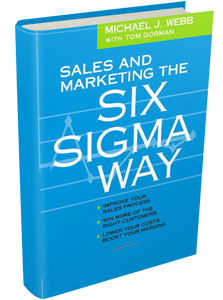
So, you can read it below. As the author of Sales and Marketing the Six Sigma Way, I am a big believer in the methodology. However, I have seen it misapplied way too many times.

I hope the message is “in their face” enough to get people’s attention while also getting people to take the message seriously.

Let me know what you think!

Until next week.

Michael Webb
March 11, 2008
www.salesperformance.com

-----------------------------------------------------------------------------------------------------------------

Salespeople Frustrated by Six Sigma Training: What to do Instead

Recently this important question was posted to the bulletin board on iSixSigma.com’s website:

"I'm doing sales, meaning getting clients for their contact center needs.  I'm in a medium-sized Call Center. How can Six Sigma help me get the clients I need?"

Posted by “Rolly.”

Now, reading between the lines, the question appears to have been posted by a salesperson. It is a very legitimate question too: “Will Six Sigma training and tools help me sell?”

Here is my answer:

Rolly,

If you mean, “Will Six Sigma training and tools help me sell,?” the answer is, “No, unless you operate directly in the Six Sigma industry, you probably do not need it, and it will not really help you do your job.”

I’m the author of Sales and Marketing the Six Sigma Way (http://tinyurl.com/2u5l8l) (Kaplan, 2006), and I never  recommend that my sales and marketing clients start  salespeople on black belt (or even greenbelt) training if they  are to do Six Sigma in sales. Money spent training salespeople  on Six Sigma is likely to have only tangential benefits at best.  Managers of sales and marketing may benefit perhaps, but  probably not most salespeople.

Now, I’m not saying that Six Sigma doesn’t work in sales and marketing. Far from it.

In fact, Lean and Six Sigma most certainly can rock the salesperson’s world.

It is just that salespeople are more like the machine operators on the plant floor: They are pawns in the game. I’m not belittling them: I am talking about designing systems that amplify and leverage salespeople’s talent. This means getting away from a situation in which companies are dependent on the salesperson’s involvement in everything, which is what most companies have today.

How to Apply Six Sigma to Sales and Marketing
If you are a salesperson, the kind of business process you have is one where the "Big Y" (the desired outcome, or effect) depends on something over which you do not have direct control. Salespeople are supposed to influence the decisions their prospects and customers make, yet those people have free will.

This distinction is profound, as I’ll discuss in a moment, but it doesn’t change Six Sigma’s fundamental approach, which is to identify all the "Little Xs" (the causes or contributing factors) that could possibly get people to buy your product or service.

So, for starters, even if you are not familiar with the terminology of Ys and Xs, or DMAIC (Define, Measure, Analyze, Improve, and Control), Six Sigma's mindset places the focus right where it obviously should be: What do we have to do to convert prospects into paying, profitable customers as efficiently as possible?

You'll likely find the Define phase of an improvement project to be a task of brainstorming and researching the variety of factors that might get people to buy from you. Believe me, they are vast and varied and become quite complex in some industries. You'll be dealing in the realm of things like:

  • How do prospects become aware of your company?
  • How do they perceive their interests and their needs?
  • How do they prioritize their problems and decide what actions to take?
  • How do they evaluate their alternative choices in your space?

Of course, you'll also be trying to define your company's work processes (and yours as a salesperson). Some work may be in the salesperson's control. Much of it may be beyond the salesperson and only in the company's direct control.

Unfortunately, in most companies, these things are based on tribal knowledge and traditions, and much of what the company does doesn’t actually help your prospects buy from you (which is, of course, exactly the problem).

If more senior managers could recognize this issue, the business world would be a better place! Unfortunately, the culture around marketing and selling (especially in the U.S.) assumes the functional mindset so deeply that most senior executives automatically assume that selling is the sales department's (or the salesperson's) problem alone. I’ve actually seen corporate executives demanding time and motion studies on the sales department in desperate, yet futile attempts to figure out their problems.

------------------------------------------------------------------------------------------------------------------
How to Turn Your Sales and Marketing Into a Lean Six Sigma Production Machine That Runs Like Clockwork (And Do It in a Way Your Salespeople Will Love!)
https://www.salesperformance.com/ExecBriefing.aspx
-----------------------------------------------------------------------------------------------------------------

The Benefits of Applying Six Sigma to Finding, Winning, and Keeping Customers
Instead of falling into the trap of the functional mindset and trying to teach salespeople about Six Sigma, most companies are in far more need of getting to first principles in their sales and marketing.

By first principles, I mean: Processes only work if they create value.

Yet identifying the value and how it is created are exactly what has never been done in the sales and marketing end of the business. Why should your customer read your ad? Respond to your offer? Take your salesperson’s call? Trust what you tell them? (Much less buy your product?)

Most important, how do you know all this? Where is the hard evidence?

Such questions are far too important to leave to chance. I currently have a client who has seen their process yield (in a call center with six agents qualifying new account opportunities for a call center with nine salespeople) a 34% increase on the strength of their ability to properly define and measure the quantity and quality of their flow of leads and opportunities, because they can now tell who they should spend time on and who they shouldn't. Further, they no longer go about chasing down unresponsive prospects like they used to; they have developed techniques to help the customers make decisions, which the customers actually acknowledge are helpful.

Yet like most management teams before they started on their Six Sigma journey,  much of what they thought they “knew” about their sales, marketing, and servicing is a mad mix of experience, tribal knowledge, and assumptions (that may have gone unchallenged for decades). It is amazing to realize that most senior marketing, selling, and servicing executives have never actually sat down to talk plainly with each other about how things actually work, who produces what, and how it should be measured.

This where the distinction I made above, about customers having free will, has its profound tectonic effect:

  • Knowing why a predictable number of prospects will read your company’s ad and respond to its offer (and having evidence to prove it) should be something the marketing manager knows every day!
  • Knowing what can be done now to ensure the sales team has enough qualified opportunities to make the numbers at the end of the quarter should be something the sales manager knows every day!
  • Knowing that the marketer and seller are getting along, and that they have the resources they need to reasonably accomplish their objectives, and that the company will achieve its objectives should be something the president knows every day!

Yet very few sellers and marketers (much less presidents) ever get the chance to know these things, caught up as they are in the false priorities imposed on them by the functional paradigm (meaning, keep on wasting time and money for those trade shows, brochures, and proposals that probably won’t close, because that's what we've always done, and it is what they've been told their job is). Oh, and, work a little harder while you're at it!

The truth is that the prospect of getting to these first principles can make people feel uncomfortable or can even seem daunting: They “don’t have time.” What hidden problems will surface? What evidence is there really to support current beliefs? You can’t blame people for fearing what the world might really look like.

However, once the team has worked through this logic (defining the customer’s journey, how to help them, and gathering the evidence and data to prove it), the enthusiasm and support for the approach becomes palpable. A common framework emerges for understanding what adds value (ie, gets customers to take an action along their journey) and what doesn’t.

The framework I refer to is similar to that of production manufacturing, where executives have been obsessively measuring conversion from raw materials, work-in-process, and finished goods for a century or so. Managers begin thinking more easily in terms of evidence and data, cause-and-effect, and accurately measuring conversions from leads, to qualified opportunities, to profit. They learn how to engage prospects in ways that compel measurable actions, whether in the form of a salesperson’s single call objective or a website’s lead generation landing page. They learn how to optimize the system as a whole rather than suboptimizing some parts and the expense of others. They learn how to better deploy precious sales talent to generate the greatest return, avoiding low-yield activities such as cold calling or spending time on prospects that won’t close.

Defining the process on the bedrock of observable facts, evidence, and data is a new frontier for sellers and marketers. Frankly, it is also a new frontier for Lean Six Sigma practitioners. Once it takes hold, however, alignment happens quickly, processes start throwing off useful data, predictability of revenue is taken for granted, and the utility of traditional Six Sigma-style statistical training becomes quite obvious.

Michael J. Webb
March 11, 2008

      February 27, 2008

      Root Out the Marketing and Selling Disconnect

      Hello,

      I’m attending a conference for Internet entrepreneurs this week in Orlando. It is interesting to compare what makes Internet marketers and corporations successful. Obviously, it is all founded on an understanding of their customers.

      A cartoon on the wall in my office shows a dog sitting in front of a computer screen with the caption, “In the Internet, no one knows you’re a dog.”

      It is true, and this puts Internet marketers at a disadvantage compared with many other kinds of business. Internet marketers must work hard to demonstrate to their customers that they are real, and that their offers are credible. Bigger corporations could learn a lot from the insightful, creative ways they do this.

      Interestingly, although these entrepreneurs don’t use jargon like “Voice of the Customer,” that is exactly what they do. Further, they isolate the characteristics of their ideal prospect, down to what that person wears, and specifically, what their frustrations are and what they want to become. They name the character, and write their articles and sales letters to this person. I’ve heard of much bigger businesses that use that technique very successfully. Then, the challenge becomes how to help that person get to where they want to be. You give them free information, really good guidance, make it easier for them to get closer to their goal. If there are people out there who fit your character, they will respond.

      All markets are the same in this respect: We are all human beings, we all have problems, and we would like to solve those problems. One of the main benefits I create for my clients comes from helping them move closer to this kind of thinking and away from the traditional, functional mindset, where marketing and selling are distinct, separate functions.

      The customer doesn’t care whether you are a marketer or a seller. They only care about solving their own problems. Your business needs to help them.

      This week’s article addresses this marketing and selling disconnect. Think about what stands in the way of helping more customers in your business, and then do something about it. You’ll be glad you did!

      Until next week.

      Michael Webb
      February 26, 2008
      www.salesperformance.com

      -------------------------------------------------------------------------------------------------------------------

      Root Out the Marketing and Selling Disconnect

      The VP of Sales and the VP of Marketing were squared off in a debate about how to invest the sales and marketing budget for the coming year.

      • Sales VP: "I want to create a new position and hire a Director of Sales and five additional salespeople."
      • Marketing VP: "I want to invest in a marketing and advertising campaign to make the B2B brand stronger."

      If the budget allows one or the other, but not both, which is the right decision to make? Isn't this a "chicken or egg" dilemma? Which comes first—sales or branding? Is there even a solution to this perennial problem?

      You bet there is. To see it, you have to get to the root of the problem, which is this: Which choice will create more value for the customer?

      What Value Does Your Sales Process Create?
      Self-interest makes prospects read headlines and respond to promotions. Decision makers are influenced by what's in it for their companies and for themselves. As individuals, marketers and sellers work hard to identify the self-interest of prospects and customers so they can be valuable to them.

      Too bad most businesses don't see the purpose of marketing and selling in terms of their value to the customer. Instead, they traditionally see marketing, selling, and servicing as activities with separate purposes. Marketing designs communications about the company and its products and "gets the word out" via branding and market-awareness exercises. The sales force turns over rocks trying to find opportunities to make their quotas. The service department tries to respond to customer needs while staying within budget. Each department essentially fends for itself.

      This approach suboptimizes results because that is what it is designed to do! It spawns conflicts over resources because of its faulty assumptions about what marketing, selling, and servicing really do.

      Anything Not Creating Value for the Customer Is Waste
      Companies would become a lot more effective and efficient (not to mention more profitable) if they designed their marketing, selling, and servicing activities to solve the prospect's or customer's problems instead of pushing their product or touting their "brand."

      Do you know what hinders people in your marketplace from doing what they want to be doing? Do you know what it costs them to deal with those problems, and what work-arounds they use? You should. You should also know how your company's offer can alleviate those problems. Answering these questions is the key to getting people to:

      • Read your advertisements
      • Take actions such as inquiring for more information or opting-in to some offer
      • Take your salespeople's calls and share information
      • Consider salespeople's proposals seriously Buy your company's solutions

      The work of your company's marketing, selling, and servicing departments should be a production system designed to generate actions like these. If it does, you are  creating value. If people don't take the actions you want  them to, what you are producing is waste.

      --------------------------------------------------------------------------------------------------------------------
      How to Turn Your Sales and Marketing Into a Lean Six Sigma Production Machine That Runs Like Clockwork (And Do It in a Way Your Salespeople Will Love!)

      https://www.salesperformance.com/ExecBriefing.aspx

      --------------------------------------------------------------------------------------------------------------------

      The Goal: Making Money Now and in the Future
      Marketing, selling, and servicing are a production system for finding, gaining, and keeping the right customers by solving problems for them so they can make more money. You might initiate promotions, hoping prospects will respond. Or, perhaps you react when prospects take certain actions. Either way this production system must have a procedure with measurable steps.

      In such an environment, marketing is anything that makes sales easier. Marketing should be analogous to engineering: It must find the niches in the market and develop the most efficient ways of mining them. Sales is like production, implementing the activities that cannot be automated. The analytical tools of the quality movement can and should be leveraged to identify causes of bottlenecks and variations in this production process so corrective actions can be taken.

      Operating this way is the key to an ever-growing stream of profitable business. It is also the best defense against changing markets, competition, and technologies.

      Root Out the Dilemma
      If marketing, selling, and servicing are seen in terms of producing value for the customer, so-called "conflicts" between marketing and sales dissolve easily. Let’s consider the "conflicting" goals again:

      • Sales VP: "I want to create a new position and hire a Director of Sales and five additional salespeople."
      • Marketing VP: "I want to invest in a marketing andadvertising campaign to make the B2B brand stronger."

      What value will either of these actions create for prospects, clients, or customers? What actions will they take as a result? How can you measure it? Chances are, both executives will have to do some thinking to answer those questions. That is good because the result of their discussion might be the first time they have actually identified their production system (aka, their sales process). In addition, it will cause them to design an approach that creates value for customers, so customers are more likely to follow it.

      Once they have a process customers follow, improving results is a matter of doing experiments. It is likely that some entirely different ideas would surface for improving results. Regardless of what they decide to do, they should be able to run two slightly different processes side by side (or sequentially) and be able to measure the result. Hire one or two salespeople, or test part of a brand campaign in one market segment. Measure the results.

      Improved results are proof you are on the right track, and provide valuable feedback on what your market wants. Best of all, this establishes a framework for measuring and maximizing the talents of marketing, sales,and service people in the service of the customer, as well as to your own company.

      Michael Webb
      February 27, 2008

      This article was originally published Aug. 3, 2005 on www.raintoday.com. 

            Links

            What People Say

            • Frank Wiley, President - Magnitude Marketing, LLC
              "Webb's breakthrough ideas show how marketing, selling, and servicing functions can be approached as a process - with input and outputs, causes and effects. I highly recommend this book to all senior executives - whether they are aiming for better forecasting, better market share, higher margins, or reduced cost of sales. It will completely change the way you view sales and marketing, and help you get a handle on sales process improvement."
            • Bill Bentley, President - Value-Train
              "Hats off to Mike Webb for tackling this challenging subject. Improving sales and marketing is like training your cat to come when you call it. It's an interesting thing to think about but full of pitfalls to the uninitiated. Mike however is very initiated and this book does a good job of showing you how quantitative methods can apply to a traditionally hard to manage business. It's not that sales forces don't have metrics. You could argue that they have the ultimate metric. Did we make the sale? Like your cat, these groups seem to have a mind of their own and the cause and effect of the activities that go into making the sale aren't usually methodically examined and improved. Mike shows you how to do that with style."
            • Jeff Kostermans President & CEO, LeadGenesys
              "Think about it... marketing and sales can easily represent nearly half of your company’s annual expenses. This expense is far from being optimized when 9 out 10 leads are typically discarded early in the sales cycle. Companies that do not apply a systematic and truly accountable approach to blending marketing and sales will undoubtedly struggle to survive in this increasingly competitive business climate. This book concisely applies practical Six Sigma methods to help companies boost customer value and realize greater ROI out of their marketing and sales investment. If you know there’s room for improvement between your marketing and sales teams, I highly recommend you leverage this book as a key competitive advantage."
            • Dan Kosch and Mark Shonka, Co-Presidents of IMPAX Corporation
              “This book is essential reading for anyone in sales and marketing. Mike Webb’s unique perspective is captured in this excellent roadmap on how to organize, measure, and lead both marketers and sellers to greater success."
            • Ray McKinney, Director of Development - Matrix Technologies
              “Michael Webb has once again demonstrated his clear and systematic thinking about delivering value to customers in this must read book, ‘Sales and Marketing the Six Sigma Way.' In this book, Mike provides tools to help measure your sales processes in terms important to your customers. Then, you can continuously improve your processes of Finding, Winning and Keeping Customers.”
            • Aaron Ross, Director, Corporate Development, Salesforce.com
              "Sales and marketing organizations have historically been slow in adopting the benefits of Six Sigma for a variety of reasons, especially because of the effort required to "translate" the ideas, tools and case studies in ways that make clearly sense to their world. Michael Webb has created a book for them that finally makes it easier to understand both what the benefits are, and how to achieve them. Thank you Michael!"
            • Perry Marshall, Principal - Perry Marshall and Associates
              "Michael Webb has a very incisive, clear-headed approach to untangling complex sales problems. 'Sales and Marketing the Six Sigma Way' breaks the sales funnel into its component parts and systematically identifies bottlenecks and disconnects that waste your time and resources. Selling might have been done by the seat-of-the-pants in the 20th century, but that isn't going to work now. Those who miss this shift will find themselves further and further behind quotas and locked in a corporate pressure cooker. But those who recognize and act will discover that the current business climate can be enormously rewarding and profitable. This book is not a sales rah-rah session. It takes enormously successful methods from manufacturing and applies them to the toughest job in your company - getting orders from customers. I wholeheartedly recommend Michael and his innovative methods."
            • Willis Turner, CAE, CSE - President/CEO, Sales and Marketing Executives International (SMEI)
              "Michael Webb brings true understanding to sales and marketing through process thinking. If you want a harmonious relationship between sales, marketing and customer service that will drive customer value, you need to read this book!"
            • Sheila Mello, Author, "Customer-Centric Product Definition"
              "If you don't know what you have done to succeed or what has caused you to fail, you are leaving your destiny to chance. In our experience, when you understand and remove obstacles to your customers achieving their objectives, you create customer value by helping them succeed. In addition, putting your own processes under the microscope can reveal the what's inhibiting you from achieving your sales goals. Michael Webb's straightforward approach to sales and marketing using the popular Six Sigma method is presented with a sense of humor and lots of examples. Well worth your time!"
            • Kamal Hassan, Global VP of Business Development, BMG
              “If more books on the subject were as concise and fun to read as 'Sales and Marketing the Six Sigma Way,' the business world would be a better place. The book will provide sales and marketing executives with money-making tools they can use daily.”
            • Jack Snader, President Systema Corporation
              "Applying Six Sigma to Sales and Marketing?? Initially I was skeptical, but after reading this book, I'm a believer. Applying these principles correctly will help sales managers solve many of the challenges they face every day in their quest to improve sales performance.”
            • Paul Greenberg, Author, CRM at the Speed of Light
              "It isn't often that I can recommend a Six Sigma book because reducing defects tends to be product focused and internally oriented. This book is not only different but better than any other Six Sigma book I've ever seen because it actually shows how to use it to increase the value of your relationships and experiences with your customers. This is the way Six Sigma should be done."
            • Gregory T. Deininger, V.P. National Accounts, Marriott
              "The name of the game is not to design the sales process around ourselves, but to create customer value. 'Sales and Marketing the Six Sigma Way' is relevant to all executives who are looking to deliver maximum results internally and externally.”
            • John Biedry, Senior Vice President Continuous Improvement, ServiceMaster
              “Sales and marketing are new frontiers for Six Sigma and Michael’s book provides practical insights for any organization that is considering how to connect their continuous improvement efforts with top line growth and customer satisfaction."
            Blog powered by TypePad